4-Color Print Ideas That Look Expensive
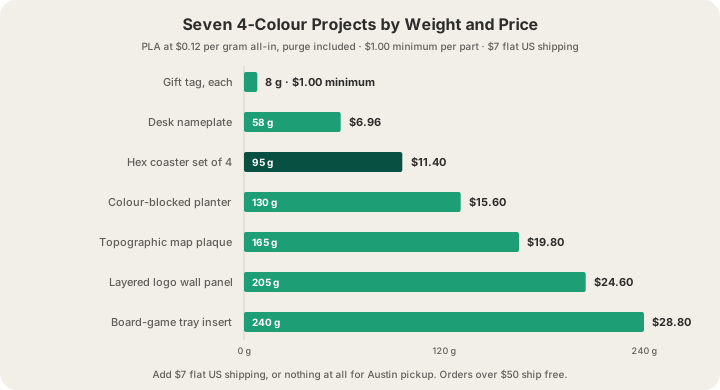
The 4-colour prints that look expensive are the ones where colour sits in a flat inlay band instead of being smeared through the whole part: inset coasters, terraced topographic plaques, colour-blocked planters. A 4-tray AMS puts four filaments on any job, and at $0.12 per gram all-in for PLA a full four-colour coaster set comes to $11.40. Seven projects that earn the look, with real weights. All of them print here from a plate you paint and slice yourself — a model we slice for you comes back in the one filament you chose.
What Makes a 4-Color Print Look Expensive
Cheap-looking multi-colour prints have soft, wandering edges and colour everywhere. The expensive ones follow the same few rules, and /blog/two-color-logos-and-signs works through the geometry behind them.
- One base colour carries most of the part; the other three read as deliberate accents.
- All the colour lives in one shallow band of layers, so the filament changes stay countable.
- Accent strokes 1.2 mm wide and up, with at least 0.8 mm of base colour between them.
- High lightness contrast, so the accents still separate in a photo shot in flat light.
Seven 4-Color Print Ideas
1. Gift tag multipack, $9.00 for ten
Ten 8 g tags, each with an initial in a second colour and a two-tone border. At 8 g a tag sits under the $1.00 per-part minimum on weight alone, so it bills at $1.00 either way and the colour is free. Ten units take 10% off: $9.00 for the set.
2. Desk nameplate, 58 g and $6.96
A slab with the name inset flush and a rule beneath it in a third colour. Printed flat, face up, the whole colour split happens inside five layers. It is the cheapest way to make a desk look considered — see also /blog/best-3d-printed-desk-accessories.
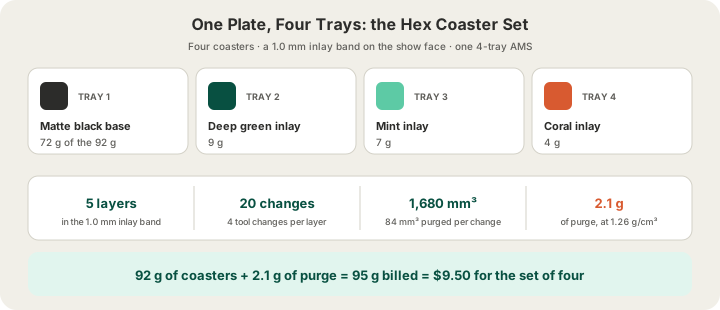
3. Inlaid hex coaster set, 95 g and $11.40
Four hexagonal coasters on one plate, each with a 1.0 mm inlay band on the show face. All four sit at the same height, so they share one set of 20 filament changes instead of paying four times over: 92 g of coasters plus 2.1 g of purge, billed at 95 g.
4. Colour-blocked planter, 130 g and $15.60
Horizontal colour blocks up a planter wall are the cheapest four-colour effect there is. Every boundary is a flat plane, so the whole part needs three changes and under half a gram of purge — almost nothing over a single-colour planter of the same weight.
5. Topographic map plaque, 165 g and $19.80
Contours stacked as terraces, each elevation band in its own colour, cycling through four filaments. The geometry is already sliced into flat Z bands, so eight terraces cost seven changes for the whole plaque. This is the one people assume was commissioned.
6. Layered logo wall panel, 205 g and $24.60
A 300 × 300 mm panel with a logo built from three inset depths, each depth a different colour. Keep every axis under 320 mm and it fits the H2S plate whole, with no seam to hide. Panels this size print overnight, comfortably inside the 24 to 48 hours most orders take to leave Austin.
7. Board-game tray insert, 240 g and $28.80
Colour-coded trays so players grab the right pieces without reading a label. Print them as four single-colour parts rather than four colours side by side: parts sharing a plate share every layer, so four colours across one plate means four changes per layer for the full height.
| Project | Colours | PLA weight | Price at $0.12/g |
|---|---|---|---|
| Gift tag multipack, ten tags | 4 | 8 g each | $9.00 for ten |
| Desk nameplate | 3 | 58 g | $6.96 |
| Inlaid hex coaster set of four | 4 | 95 g | $11.40 |
| Colour-blocked planter | 4 | 130 g | $15.60 |
| Topographic map plaque | 4 | 165 g | $19.80 |
| Layered logo wall panel | 4 | 205 g | $24.60 |
| Board-game tray insert | 4 | 240 g | $28.80 |
What the Fourth Colour Actually Adds
Only two things: purge and machine time. Each change flushes 84 mm³ out of the hot end, about 0.11 g at PLA's 1.26 g/cm³, and the seconds spent switching bill at $1.50 per hour instead of being folded into the per-gram rate. What four colours never do is multiply the price of the plastic, which stays $0.12 per gram. /blog/how-long-does-3d-printing-take covers the clock, and /pricing has every rate.
FAQ
How many colours can one 3D print have?
Four in a single job, fed by the 4-tray AMS on each of our Bambu Lab H2S and P2S machines. More than that means splitting the design into parts that assemble, which is often the better answer anyway.
Does a 4-colour print cost four times as much?
No. The coaster set above is 92 g of plastic plus 2.1 g of purge, so four colours added 36 cents to an $11.04 set. The parts that get genuinely expensive are the ones where every layer contains every colour, which is a geometry choice rather than a colour count.
What file should I send for a multi-colour print?
A sliced .gcode.3mf, with the filament slots already assigned. That is the only file that arrives with the colour split inside it: a painted 3MF is not enough on its own, because nothing in our pipeline turns paint into filament assignments, and STL and GLB never carried colour in the first place. We take STL, GLB and 3MF up to 100 MB at /print for single-colour work. OBJ is not accepted.
Ready to get started?
Upload a 3D model for instant pricing, or generate one with AI.