Is 3D Printing Safe? Fumes, Materials, and Food Contact
Yes, FDM 3D printing is safe for normal use, as long as you handle three separate things: ventilation while the machine runs, the plastic you choose, and what the finished part is allowed to touch. Melting plastic gives off vapour and fine particles, some filaments give off far more than others, and a layered plastic part is a poor surface for food no matter what the spool said. None of these risks are exotic and all three have straightforward answers. Here is what each one actually is, and how much it should change what you do.
The Three Real Risks of 3D Printing
Almost every safety question about 3D printing collapses into one of three categories. Keeping them separate matters, because the answers are different and people routinely apply the answer from one to another. PLA being pleasant to print next to does not make a PLA cup a good idea, and ABS needing an open window does not make an ABS bracket dangerous to hold.
- Air. What comes off the nozzle as vapour and ultrafine particles while the print runs. This is the risk that depends most on which material you load.
- Material. What the plastic itself is made from, plus whatever pigments and additives the manufacturer blended in. This one follows the part after it cools.
- Contact. What the finished part rubs against — skin, water, heat, food — and how easy it is to clean. This is almost entirely about geometry, not chemistry.
Fumes: What Comes Off a Print While It Runs
A hot end pushes plastic through a nozzle at 190 to 270°C depending on the material. At those temperatures a small fraction of the polymer and its additives leaves as vapour, and that vapour condenses in the air into particles far too small to see. The amount and the character of what is released scale with two things: how hot the nozzle runs, and what the polymer is. Everything else, including brand and colour, is noise next to those two.
Your nose is a decent first instrument here. PLA at 210°C smells faintly sweet and most people never notice it. ABS at 250°C smells like a hot glue gun crossed with a model kit, and that smell is styrene, which is exactly why the advice for ABS and ASA is different in kind, not just in degree.
| Material | Typical nozzle range | Smell while printing | What the room needs |
|---|---|---|---|
| PLA | 190–220°C | Faint, slightly sweet | Normal room air, a cracked window |
| PETG | 230–250°C | Very mild | Normal room air, a cracked window |
| TPU | 220–240°C | Mild, rubbery | Normal room air, a cracked window |
| ABS | 240–260°C | Strong, plasticky | Vent outdoors, enclosure recommended |
| ASA | 250–270°C | Strong, plasticky | Vent outdoors, enclosure recommended |
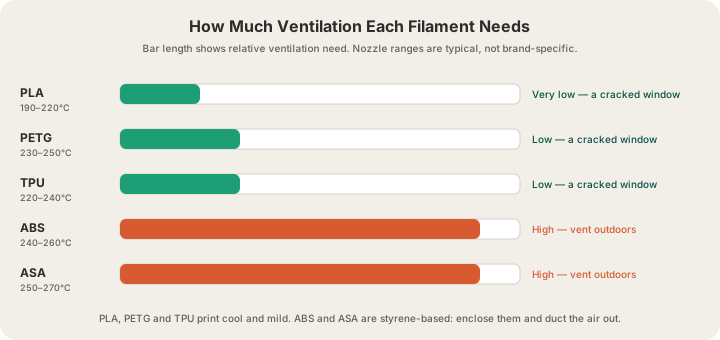
Two practical points get lost in the fume conversation. First, an enclosure on its own does not remove anything from your air — it holds warm air around the part so ABS stops warping, and it delays the release rather than preventing it. Enclosure plus extraction is the pair that works. Second, the emission rate is not constant: it peaks in the first minutes as the hot end comes up to temperature and purges, which is precisely when people stand over the machine watching the first layer. Start the print, then step away.
If you print PLA in a room you also sleep in, the honest advice is still to ventilate — not because PLA is dangerous, but because there is no reason to breathe anything you do not have to, and opening a window costs nothing.
Material Safety: What the Plastic Actually Is
Once a part is printed and cool, it is an inert piece of thermoplastic. The interesting differences are in what the base polymer is and what happens if the part gets hot, chewed, or left in the sun. Our full breakdown of strength, heat and UV behaviour lives in /blog/pla-vs-petg-vs-abs-vs-asa-vs-tpu; this table is the same five materials read through a safety lens.
| Material | Base polymer | What to know | Comfortable use |
|---|---|---|---|
| PLA | Polylactic acid, from plant starch | Lowest print temperature, mildest emissions, softens near 50°C | Indoor parts, display pieces, prototypes |
| PETG | Polyethylene terephthalate glycol | Same polymer family as drinks bottles, tough, holds to about 75°C | Functional parts, planters, food-adjacent housings |
| ABS | Acrylonitrile butadiene styrene | Styrene-based, strong odour, needs extraction while printing | Hot environments, enclosed and vented setups |
| ASA | Acrylonitrile styrene acrylate | ABS chemistry plus UV stability, same ventilation rules | Outdoor parts that must not yellow |
| TPU | Thermoplastic polyurethane | Rubber-like, low odour, hardness tuned by infill rather than blend | Grips, bumpers, dampeners, wearables |
That last row is a real design lever rather than a footnote. A TPU part at 15% infill squashes like foam and the same part at 60% feels almost rigid, which is why we set hardness with density instead of switching materials — the mechanics are in /blog/3d-printing-infill-explained.
Is a 3D Print Food Safe?
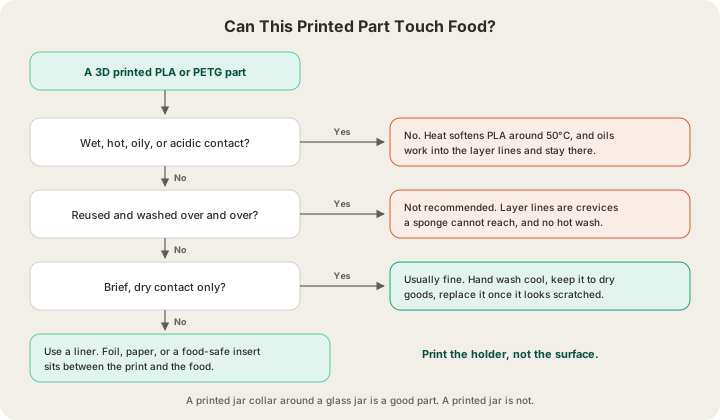
The short answer is that a printed part is usually not food safe, and the plastic is rarely the reason. Three things stack up against it, and only the first is about chemistry at all.
- Geometry. Layer lines are a continuous spiral of microscopic crevices running around the whole part. Bacteria settle into them, and a sponge cannot reach in. A smooth injection-moulded bowl has nowhere for anything to hide; a printed one is all hiding places.
- Process. The filament passes through a hot end, a nozzle and a build plate that were never designed as food-processing equipment, and it sits in open air on a spool for weeks beforehand.
- Cleaning. The one method that would actually solve the geometry problem is high-temperature washing, and PLA softens around 50°C — well under a dishwasher's hot cycle. The cleaning that would help is the cleaning that destroys the part.
| Use | Verdict | Why |
|---|---|---|
| Cookie cutter, dry scoop, chip clip | Usually fine | Contact is brief and dry, and the part is easy to replace |
| Cake topper, tray insert, place card | Fine with a liner | The print holds something; it never touches the food |
| Reusable cup, bowl or plate | Not recommended | Warm, wet, repeated contact with no way to sanitise it |
| Anything hot, oily or acidic | No | Heat softens PLA, and oils work into layer lines and stay |
| Baby bottles, cutting boards, cookware | No | Use a moulded, certified product; this is not the place to save $4 |
If you insist on getting as close as the process allows, the recipe is: PETG rather than PLA, so the part survives hot hand-washing; heavy wall counts and high infill so there are no internal voids to trap water; a 0.1 mm layer height to shrink the crevices; and hand-washing in cool water with replacement as soon as the surface looks scratched. Some people seal parts with a food-safe epoxy, which moves the question to whether the coating is still intact — a reasonable trade for a one-off, not for daily use.
Fire and Machine Safety
A 3D printer is an appliance with a 250°C heater and a moving gantry that runs unattended for hours at a time. Modern machines handle this well: thermal runaway protection cuts power if a thermistor reading stops tracking the heater, and firmware refuses to extrude below temperature. The residual risks are the mundane ones — a printer on a carpet, a spool of filament resting against the hot end, a stack of paper next to the build plate.
This is where running a farm changes the calculation rather than the physics. Our Bambu Lab H2S and P2S machines sit on a monitored floor in Austin with live camera streams on every unit, so a failure is seen rather than discovered. Every job passes G-code safety validation before it reaches a machine, which catches the temperature and movement commands that have no business being in a print file, and finished plates auto-eject so a completed job does not sit on a hot bed waiting for someone to arrive. You can see how the rest of that pipeline works at /farm.
The Lowest-Risk Way to Get a Printed Part
For most people asking whether 3D printing is safe, the practical answer is that the whole question belongs to whoever owns the printer. Upload a model at /print and the fumes, the fire risk and the 3 a.m. failed print are all our problem. PLA is $0.12 per gram all-in — filament and machine time together — with a $1.00 minimum per part and $7 flat shipping anywhere in the US. Quotes come from a real OrcaSlicer slice of your file rather than a bounding-box guess, so the grams you are charged for are the grams that actually go into the part.
We accept STL, GLB, 3MF and G-code (.gcode or .gcode.3mf). OBJ is not accepted, so export or convert before you upload — /blog/stl-vs-obj-vs-3mf-vs-step-export-formats-explained covers which format to pick and why. The build volume is 340 × 320 × 340 mm, the AMS holds four filaments per machine for multi-colour work, and if you are in Austin you can pick the part up rather than ship it. If any of the terminology in this post was new, /blog/3d-printing-glossary defines the whole vocabulary one line at a time.
FAQ
Is PLA toxic?
PLA is a plant-derived polyester and is not considered toxic to handle. It prints at the lowest temperatures of the common filaments and gives off the least odour, which is why it is the default for indoor printing. That is a statement about the base polymer, though — pigments and additives vary by brand, and a PLA part still is not a food-contact surface for the geometry reasons above.
Do I need an enclosure or an air filter to print at home?
For PLA, PETG and TPU, a normally ventilated room is enough; open a window and do not sleep beside the machine. For ABS and ASA, treat it like solvent work: an enclosure to keep the part from warping, plus a duct or a filter that actually moves air out of the space. An enclosure alone traps the fumes rather than removing them, so it is not a substitute for ventilation.
Can I put a 3D print in the dishwasher?
Not a PLA one. PLA starts softening near 50°C and a dishwasher's wash and dry cycles go well past that, so parts come out warped or collapsed. PETG survives a top-rack cycle far more often, but the layer lines that made the part unsuitable for food are still there afterwards. Hand-wash in cool water and treat printed kitchen parts as consumables.
Are 3D printed toys safe for children?
For older children, a smooth PLA or PETG print with no thin protrusions is a reasonable toy. For anything a small child might chew or swallow, no: printed parts are not certified to toy-safety standards, layer lines hold whatever they are exposed to, and a thin printed piece can snap into a sharp fragment. Print the display model, buy the teether.
Ready to get started?
Upload a 3D model for instant pricing, or generate one with AI.